

What is the hardness requirement for hammer mill spares?
Leave a message

Hey there! As a supplier of Hammer Mill Spares, I've been getting a lot of questions about the hardness requirements for these parts. So, I thought I'd take a moment to break it down for you.
First off, let's talk about why hardness matters. In a hammer mill, the spares are constantly subjected to high - impact forces and abrasion. Whether it's the hammers themselves, the liners, or other components, they need to be tough enough to withstand the wear and tear of the milling process. If the parts aren't hard enough, they'll wear out quickly, which means more frequent replacements, downtime for your mill, and ultimately, higher costs.
Now, when it comes to determining the right hardness for hammer mill spares, there are a few factors to consider.
Material of the Feedstock
The type of material you're grinding in the hammer mill plays a huge role. If you're working with soft materials like grains or wood chips, you might not need spares with extremely high hardness. These materials are less abrasive, so the spares won't face as much wear. However, if you're dealing with hard and abrasive materials such as minerals, ores, or recycled concrete, you'll need spares with a much higher hardness.
For example, if you're using a hammer mill to process limestone, which is relatively soft, a moderately hard hammer and liner set might do the job. But if you're grinding quartz, a very hard mineral, you'll need spares made from materials with high - end hardness properties.
Operating Conditions
The way the hammer mill is operated also affects the hardness requirements. If the mill is running at high speeds and with high throughput, the spares will experience more intense impacts and abrasion. In such cases, you'll want spares with greater hardness to ensure they can handle the stress.
On the other hand, if the mill is running at lower speeds and with a lower volume of material, the wear on the spares will be less severe. So, you might be able to get away with spares that have a slightly lower hardness.
Types of Hammer Mill Spares and Their Hardness Needs
Hammers
Hammers are one of the most critical parts of a hammer mill. They're the ones that actually break down the material. For hammers used in general - purpose grinding of soft to medium - hard materials, a hardness in the range of 40 - 50 HRC (Rockwell Hardness Scale) is often sufficient. This allows them to break the material effectively without being too brittle.
However, for hammers used in high - abrasion applications, such as grinding metal scrap or hard minerals, the hardness can go up to 60 HRC or even higher. High - hardness hammers are made from special alloys that can resist the intense wear caused by the hard feedstock.
Liners
Liners line the inside of the hammer mill chamber and protect the mill body from wear. They also play a role in the grinding process by helping to bounce the material back into the path of the hammers. For liners in mills processing soft materials, a hardness of around 30 - 40 HRC can work well.
When dealing with harder materials, liners need to be much harder, typically in the range of 50 - 60 HRC. This hardness helps them withstand the constant impact and abrasion from the material being ground.
Screen Plates
Screen plates are used to control the size of the output material. They need to have a certain level of hardness to resist wear from the material passing through the holes. For soft materials, a hardness of 35 - 45 HRC can be appropriate. For harder materials, the hardness should be increased to 45 - 55 HRC.

Our Offerings
As a supplier of Hammer Mill Spares, we understand the importance of getting the hardness right. We offer a wide range of spares with different hardness levels to meet the diverse needs of our customers.
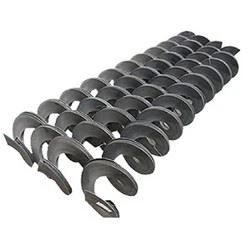
We also have some other great products in our portfolio. Check out our SRMC Series Ribbon Mixing Coater, which is perfect for coating applications. And if you're in the market for a pellet mill, our SMPM Series Single Motor Pellet Mill is a reliable choice. We also supply Continuous Cold Rolled Screw Flight for your conveying equipment needs.
Why Choose Us
When you choose us as your Hammer Mill Spares supplier, you're getting high - quality parts that are carefully engineered to meet the right hardness requirements. We use advanced manufacturing techniques and the best materials to ensure our spares are durable and perform well.
Our team of experts is always available to help you select the right spares for your specific application. We can analyze your feedstock, operating conditions, and other factors to recommend the spares with the optimal hardness.
Let's Connect
If you're in the market for Hammer Mill Spares or any of our other products, don't hesitate to reach out. We're here to make sure you get the best parts for your equipment at a great price. Whether you have questions about hardness requirements or need a quote, we're just a message away. Start a conversation with us today and let's work together to keep your operations running smoothly.
References
- "Handbook of Industrial Hammer Mills" - A comprehensive guide on the design, operation, and maintenance of hammer mills.
- "Materials Science for Engineers" - A textbook that provides in - depth knowledge about the properties of different materials, including hardness and its importance in industrial applications.


