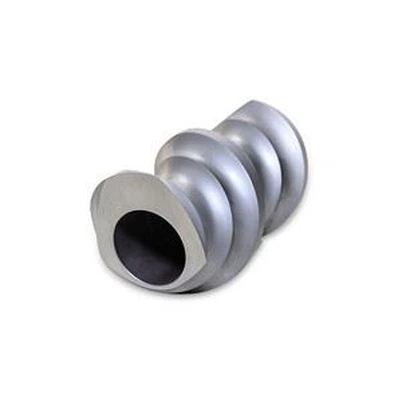
How to calculate the compression ratio of an Extrusion Screw?
Leave a message

As a well - established extrusion screw supplier, I often encounter customers who are curious about how to calculate the compression ratio of an extrusion screw. Understanding the compression ratio is crucial for achieving the desired extrusion performance, such as product quality, output rate, and energy efficiency. In this blog, I will comprehensively explain how to calculate the compression ratio and its significance in the extrusion process.
What is the Compression Ratio of an Extrusion Screw?
The compression ratio of an extrusion screw is defined as the ratio of the volume of the material at the feed section to the volume of the material at the metering section of the screw. It reflects the degree of squeezing and compaction of the plastic or other materials during the extrusion process. A proper compression ratio can ensure that the material is well - melted, mixed, and conveyed through the extruder.
Why is the Compression Ratio Important?
Before delving into the calculation methods, it's essential to understand why the compression ratio matters. A suitable compression ratio affects several key aspects of the extrusion process:
- Melting and Homogenization: Adequate compression helps to generate the necessary heat and pressure for melting the raw material. It also promotes better mixing of additives, colorants, and other components, resulting in a more uniform product.
- Output and Efficiency: The right compression ratio can optimize the flow rate of the material through the extruder. If the compression ratio is too low, the material may not be properly compacted, leading to reduced output. Conversely, an excessively high compression ratio can cause over - heating, increased energy consumption, and even damage to the extruder.
- Product Quality: The compression ratio influences the physical and mechanical properties of the extruded product. For example, in plastic extrusion, it can affect the density, strength, and surface finish of the final part.
Calculation Methods for Compression Ratio
There are two common methods to calculate the compression ratio of an extrusion screw: based on the channel depth and based on the volume.
Calculation Based on Channel Depth
The most straightforward way to calculate the compression ratio is by using the channel depths at the feed and metering sections of the screw. The formula is as follows:
[CR=\frac{H_{f}}{H_{m}}]
Where (CR) is the compression ratio, (H_{f}) is the channel depth at the feed section, and (H_{m}) is the channel depth at the metering section.
Let's take an example. Suppose the channel depth at the feed section of an extrusion screw is 10 mm, and the channel depth at the metering section is 2 mm. Using the formula, the compression ratio is:
[CR = \frac{10}{2}=5]
This means that the material is compressed by a factor of 5 as it moves from the feed section to the metering section of the screw.
Calculation Based on Volume
The compression ratio can also be calculated by considering the volume of the screw channels. The formula for calculating the volume of a screw channel is:
[V = \pi(D - \frac{H}{2})H]
Where (V) is the volume of the screw channel per unit length, (D) is the screw diameter, and (H) is the channel depth.


The compression ratio based on volume is then calculated as:
[CR=\frac{V_{f}}{V_{m}}]
Where (V_{f}) is the volume of the screw channel per unit length at the feed section, and (V_{m}) is the volume of the screw channel per unit length at the metering section.
For instance, if the screw diameter (D = 50) mm, the channel depth at the feed section (H_{f}=10) mm, and the channel depth at the metering section (H_{m} = 2) mm.
First, calculate the volume at the feed section:
[V_{f}=\pi(50-\frac{10}{2})\times10=\pi\times45\times10 = 450\pi]
Then, calculate the volume at the metering section:
[V_{m}=\pi(50-\frac{2}{2})\times2=\pi\times49\times2=98\pi]
The compression ratio is:
[CR=\frac{450\pi}{98\pi}\approx4.6]
This slight difference in the compression ratio calculated by the two methods is due to the assumptions and simplifications in the calculations. In practice, the method based on channel depth is more commonly used as it is simpler and provides a reasonable approximation.
Factors Affecting Compression Ratio Selection
When choosing the appropriate compression ratio for an extrusion screw, several factors need to be considered:
- Material Properties: Different materials have different melting and flow characteristics. For example, polymers with low viscosity, such as polyethylene, usually require a lower compression ratio (around 2 - 3), while high - viscosity polymers, like polycarbonate, may need a higher compression ratio (around 3 - 4).
- Extrusion Process Requirements: The type of extrusion process, such as film extrusion, pipe extrusion, or profile extrusion, can also influence the compression ratio. For instance, in precision extrusion processes, a more precise and well - controlled compression ratio is often needed to ensure product quality.
- Screw Design: The overall design of the screw, including the flight pitch, helix angle, and the number of flights, can interact with the compression ratio. For example, a finer pitch screw may require a different compression ratio compared to a coarser pitch screw to achieve the same material flow and compaction.
Our Extrusion Screw Offerings
As a supplier of extrusion screws, we offer a wide range of products tailored to different applications. Our extrusion screws are designed with precision and manufactured using high - quality materials to ensure reliable performance and long - term durability.
In addition to our extrusion screws, we also provide other related products that can enhance the extrusion process. For example, if you are looking for a pelletizing solution, our SGPM Series Ring Die Pellet Mill is a great choice. It is designed for efficient pellet production with excellent energy efficiency and high output.
We also offer spare parts for conveying equipment. The Equal Thickness Continuous Screw Flight is a reliable component that can be used to replace worn - out screw flights, ensuring the smooth operation of your conveying system. And for maintaining the cleanliness of your bucket elevators, our Bucket Elevator Washer is an essential tool.
Contact Us for Procurement
If you are in the market for high - quality extrusion screws or any of our related products, we invite you to contact us for a detailed discussion. Our team of experts is ready to assist you in selecting the right products based on your specific requirements, including the appropriate compression ratio for your extrusion process. Reach out to us to start a successful procurement negotiation and take your extrusion operations to the next level.
References
- Tadmor, Z., & Gogos, C. G. (2006). Principles of Polymer Processing. Wiley - Interscience.
- Rauwendaal, C. (2014). Polymer Extrusion: Principles and Practice. Hanser Publishers.